November 3, 2026 · DEVELOPMENT · AI AGENTS · SECURITY · ORCHESTRATION
Popularity Isn't Fit: MLflow for Agent Engineering
Overview
MLflow crossed 1.21 billion cumulative PyPI downloads on pepy.tech. The repo shows 28,641 GitHub stars. The README claims 60+ million monthly downloads and markets the project as the open source AI engineering platform for agents, LLMs, and models.
That footprint makes MLflow feel like the default stack for agent work. I don't treat it that way on day one, at least not as a full server-and-registry install.
First catch — pick a path
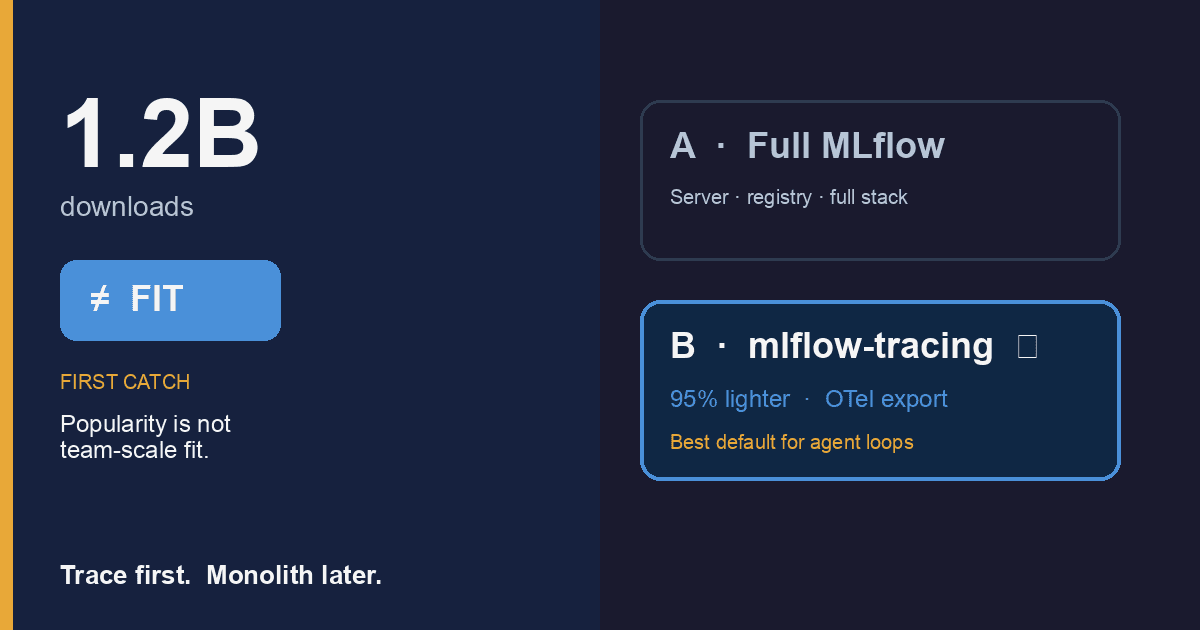
1.2B downloads ≠ the right install for agent work.
| Path | What you stand up | Best when |
|---|---|---|
| A · Full MLflow | Server, storage, registry, UI | You need eval + gateway + shared catalog this quarter |
B · mlflow-tracing ✓ | 95% lighter SDK, OTel export | You need spans on an agent loop first |
Work the checklist before you pick A by reflex:
- I can debug one agent failure from spans alone
- Registry + batch eval + gateway are on this quarter's critical path
- More than ~5 engineers will write to the same tracker daily
- We already run an OpenTelemetry collector
If the first box is unchecked, choose B. If the middle boxes are unchecked, still choose B. Choose A when those gates are real — not when the download counter shames you into ops.
A 252-point Hacker News thread on Eduardo Blancas's lightweight-tracking essay still asks a blunt question: why not SQLite? 110 comments of practitioner friction sit next to billion-scale download charts. Popularity measures installs and mindshare. It does not measure whether your team should stand up the whole platform before the first useful agent trace.
What the headline numbers actually measure
Download counters mix cumulative PyPI history, marketing claims, and doc copy that can lag live GitHub stats. Treat them as signal of adoption, not a prescription:
| Metric | Source | What it suggests |
|---|---|---|
| ~1.21B cumulative PyPI downloads | pepy.tech | Long tail of pip install mlflow across notebooks, tutorials, and CI |
| 60+ million monthly downloads | MLflow README | Vendor-scale usage claim — different denominator than lifetime PyPI |
| 28,641 GitHub stars | GitHub API | Strong OSS visibility, not production fit |
| 60+ one-line auto-tracing hooks | README integrations | GenAI repositioning — easy to turn on, still backed by storage and UI |
Enterprise delivery stats tell a parallel story. Gartner's Q4 2023 survey (press release) found 48% of AI projects reach production on average, with an 8-month prototype-to-production cycle. Teams buy platforms when they need governance at scale — not because a README says "agents."
Practitioner pushback (not vendor docs)
The Ploomber/HN discussion is old by internet standards (2022) and still cited because the complaints recur in production threads:
"I think MLflow is a good idea (very) badly executed… not really ready for large-scale production, or for use by teams bigger than about 5. It's kind of flaky and slow. It doesn't have namespacing."
Another commenter on the same HN item echoed team-scale pain: shared library use gets slow, and environment setup for a central tracker fights ad hoc experiments.
One HN thread is not a benchmark suite. Still, it matches what I see when teams treat "we installed MLflow" as finished observability work:
- Server and storage before the first trace that changes a design decision
- Latency once experiments are shared across a squad
- Full-package weight when the job is span visibility on an agent loop
- GenAI marketing (eval, gateway, prompt registry) layered on top without shrinking the ops tax
Popularity is not team-scale fit.
Two legitimate positions
| Position | Summary | When it wins |
|---|---|---|
| Unified OSS platform (MLflow docs) | Tracing, 50+ eval scorers, prompts, AI Gateway, classic registry — one self-hosted stack | You need registry + eval + gateway + shared UI under your data boundary |
| Lightweight / portable observability (OTel LLM guide, HN skeptics) | SQLite or local trackers, or OTel export to Jaeger/Prometheus/your backend | Small team, fast iteration, agent loop still changing daily |
MLflow 3's release notes (v3.1.0) explicitly reframed the product around GenAI: trace-centric artifacts, shared scorers dev→prod, prompt optimization. Classic MLOps (2018 Databricks launch) was run-centric experiment tracking. The pivot is real. So is the install surface if you only wanted spans.
Trace-first for agent loops
For agent engineering, the question is not "MLflow yes or no." It is which slice matches how you ship today.
MLflow Tracing documents a mlflow-tracing SDK with a 95% smaller footprint than the full mlflow package, OpenTelemetry-compatible export, and one-line autolog hooks for major frameworks. That aligns with the OpenTelemetry project's LLM observability framing: traces for RAG and agent step sequences, metrics for latency and token/cost counters, payloads handled as events where span attributes would bloat.
Start by tracing the loop you actually run — planner, tools, retries — not by provisioning a monolith because the homepage says "agents."
# Purpose: minimal autolog — inspect spans before committing to a shared server
import mlflow

mlflow.openai.autolog()  # or the integration for your framework

# Run one real agent session; read traces locally or export via OTel
with mlflow.start_run(run_name="agent-smoke"):
    ...  # your agent entrypoint
When you outgrow a laptop UI, export to the backend your platform team already runs:
# Purpose: keep instrumentation portable — OTel path from MLflow tracing docs
import os

os.environ["MLFLOW_ENABLE_OTEL_TRACING"] = "true"
# Point OTEL_EXPORTER_OTLP_ENDPOINT at your collector (Jaeger, Grafana Tempo, etc.)
Builders who need full lifecycle tooling still have a coherent story. The Plexe Show HN thread describes a team that rebuilt around multi-agent orchestration and standardized on MLflow logging after brittle single-graph flows failed — 130 points of evidence that some agent systems do want a shared experiment trail. The mistake is assuming that narrative applies on week one of every side project.
A practical decision checklist
Use this before you uvx mlflow server by reflex:
- Can you explain one agent failure from spans alone (tool call, model turn, retry)?
- Do you need model registry, batch eval, and gateway routing in the same quarter?
- Will more than ~5 engineers write to the same tracking store daily?
- Does your org already operate an OTel collector and retention policy?
If the first box is unchecked, fix instrumentation — not catalog size. If the middle boxes are unchecked, mlflow-tracing or raw OTel beats standing up every GenAI module. If the last box is checked, export there first; MLflow UI becomes optional glue, not the critical path.
Evaluation-heavy teams should read MLflow's eval-monitor docs and the production agent benchmarking study on arXiv (574 historical runs; 200 questions captured 38.5% of a full benchmark with 1.03 percentage points MAE on overall score fidelity). Full agent eval reruns are expensive; that is a reason to invest in eval infrastructure when agents ship — not a reason to block tracing until eval is perfect.
Nutshell
1.2 billion PyPI downloads and a GenAI-first README prove MLflow is everywhere. They do not prove your agent team needs the full platform on day one. HN's SQLite skepticism and decade of MLOps lineage both point at the same split: trace the loop first, monolith later. Reach for mlflow-tracing or OpenTelemetry export when spans are the bottleneck; reach for registry, gateway, and shared eval when those gates are real — not when the download counter shames you into ops you are not ready to run.