September 21, 2026 · AI · RESEARCH · DEVELOPMENT
A Math Rumor Can Now Outspend the Clay Prize
The economics look backwards
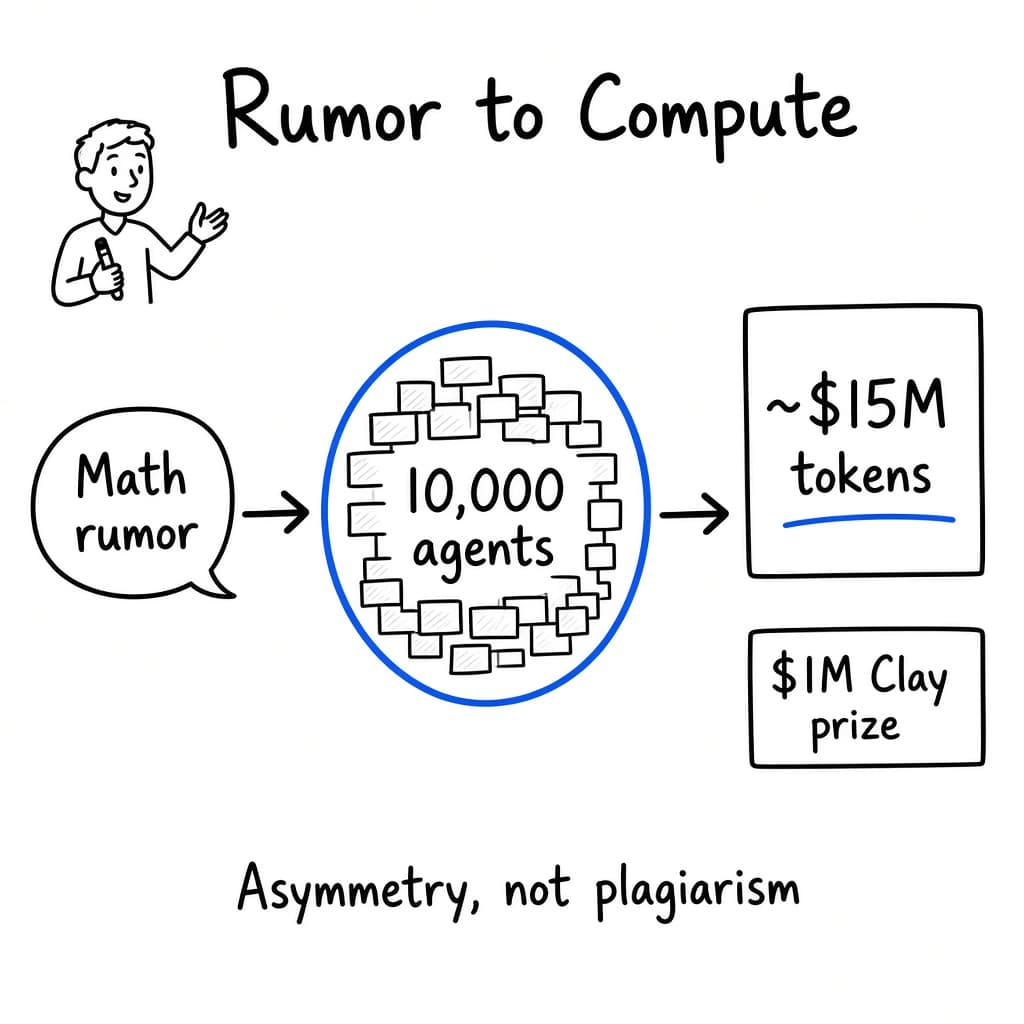
On paper, OpenAI spent roughly fifteen times the Clay Mathematics Institute bounty to chase a single Millennium Prize problem. Simon Willison's estimate puts the public API cost of ~300 billion output tokens at around $15 million — against a $1 million prize per solved problem.
That ratio reads like a blunder until you ask what a rumor buys in 2026.
On September 1, after whispers that a Millennium problem was falling, OpenAI launched roughly 10,000 concurrent agents across all seven Clay problems. By September 5 — about 88 hours after the swarm went live — the Navier–Stokes claim was done. Lean verification took another 17 hours. Navier–Stokes alone consumed ~130 billion output tokens across 2.7 million agent messages.
The prize was never the point. A rumor became a trigger for industrial-scale compute that no individual lab, grant, or mathematician can match.
What actually broke trust in mathematics
The public argument has centered on plagiarism: did OpenAI lift Tristan Buckmaster's unpublished Codex drafts? Did it train on private ChatGPT sessions like those Andreas Thom described?
Those questions matter. But they are not the whole story — and Buckmaster himself has been careful about the framing. He is not accusing OpenAI of having used their data in a direct lookup sense. His fight is about training on Codex sessions and racing once rumors start, not about someone copying a PDF from his laptop.
The deeper fracture is compute asymmetry. You do not need unpublished drafts when rumor → compute is already a weapon.
| Dimension | Traditional math research | OpenAI Navier–Stokes run |
|---|---|---|
| Trigger | Years of focused collaboration | Internet rumor, Sept 1 |
| Time to claimed result | ~1 year (Buckmaster/Alpöge program) | ~88 hours after agent launch |
| Compute budget | Grant-scale; paid tools from research funds | ~130B tokens on one problem; ~300B total |
| Public cost estimate | N/A | ~$15M at public API rates |
| Prize upside | $1M Clay bounty | Reputation, model capability, press |
| Peer review pace | Months to years | Announcement before community digestion |
As Javier Gómez-Serrano put it, very few mathematicians will ever command resources at that scale. The asymmetry is not marginal. It is structural.
The flattened difficulty landscape
Terence Tao named the mechanism plainly:
AI tools have flattened the difficulty landscape, destroying the ability to locate promising new problems.
And the line that should keep every working mathematician up at night:
Even the rumor of someone working on a problem can trigger a massive amount of AI-powered effort to flatten it before the original research project has time to reach its full potential.
Tao is not arguing that AI proofs are fake. He is arguing that premature, opaque, rumor-driven resolution can contaminate the communal process — the slow mapping of which problems are hard, which approaches are promising, and who gets credit for opening a line of attack.
Buckmaster and Levent Alpöge had worked on forced Euler blowup for roughly a year, using Claude and Codex as thinking partners, with a breakthrough on August 15. Both teams followed the Córdoba–Martínez-Zoroa program. OpenAI's proof differed on forced vs. unforced Euler — a real mathematical distinction — but the race dynamic started before either side had finished the human work of publication, attribution, and peer scrutiny.
That is the trust failure. Not a lookup table. A flattened landscape where whispers mobilize ten thousand agents before your paper is ready.
A toy model of the burn rate
Public numbers make the asymmetry legible without pretending we know OpenAI's internal unit economics. Willison's back-of-the-envelope uses GPT-6 Astra API pricing on total output tokens:
# Public-rate estimate (Simon Willison, Sep 2026)
# https://simonwillison.net/2026/Sep/8/on-navier-stokes/

OUTPUT_TOKENS_TOTAL = 300_000_000_000      # all Millennium attempts, one week
OUTPUT_TOKENS_NAVIER_STOKES = 130_000_000_000
COST_PER_MILLION_OUTPUT = 50.0             # USD at public Astra rates (illustrative)

total_usd = (OUTPUT_TOKENS_TOTAL / 1_000_000) * COST_PER_MILLION_OUTPUT
ns_usd = (OUTPUT_TOKENS_NAVIER_STOKES / 1_000_000) * COST_PER_MILLION_OUTPUT
clay_prize = 1_000_000

print(f"Total week burn (public rates): ${total_usd:,.0f}")
print(f"Navier–Stokes slice:            ${ns_usd:,.0f}")
print(f"Clay bounty per problem:        ${clay_prize:,.0f}")
print(f"Ratio (total / prize):          {total_usd / clay_prize:.0f}x")
At those illustrative rates you get ~$15M against a $1M prize — before counting the hardware, staffing, and opportunity cost of running ~10,000 concurrent agents. OpenAI's internal marginal cost is almost certainly lower than the public API sticker price. The asymmetry versus any individual researcher is worse than the headline ratio suggests.
What the agent swarm actually does
Strip away the Millennium Prize branding and the loop is familiar to anyone building agent systems — just scaled past any sane grant line item:
// Conceptual rumor-driven research loop (not OpenAI pseudocode)
async function rumorDrivenSolve(rumor: string) {
  const targets = allMillenniumProblems(); // launched Sept 1, 2026
  const agents = spawnConcurrent(10_000);

  for (const problem of targets) {
    let messages = 0;
    let tokens = 0;

    while (!claimedResolved(problem) && withinBudget(problem)) {
      const draft = await agents.propose(problem, rumor);
      const checked = await leanVerify(draft);
      messages += agents.messageCount;
      tokens += agents.outputTokens;
      if (checked) return publish(problem, { messages, tokens });
    }
  }
}
OpenAI's own post reports 4.9 million messages and ~300 billion output tokens across the week's run. Navier–Stokes alone: 2.7 million messages, ~130 billion tokens. The loop is not mysterious. The scale is.
Training, access, and the wrong debate
The Thom and Buckmaster threads expose a second asymmetry: information.
Researchers asked two distinct questions — (1) did our conversations enter training data, and (2) were they accessible during inference — and received answers that collapsed those mechanisms into a single denial. OpenAI's language evolved from "no specific user data was accessed" to acknowledging it cannot rule out that de-identified usage data helped improve models, to a September 10 update claiming Buckmaster's Codex prompts could not have influenced the system including through training.
Thom's point is procedural: we are not required to reverse-engineer OpenAI's training pipeline. Only OpenAI holds the lineage data. Default-on "Improve the model for everyone" settings mean months of unpublished mathematical thinking may have entered the training pool before a researcher toggles opt-out — and opt-out is prospective, not auditable from outside.
But even if every training-data question were answered tomorrow, the rumor-compute weapon would remain. Buckmaster paid for Codex from his own research funds, put a year of drafts into the tool, and still faced a frontier lab that heard a rumor and committed millions in tokens within a week. The plagiarism frame asks whether someone stole a file. The compute frame asks whether open science can survive when a whisper can flatten a problem before the humans who found the route can publish it.
What changes for working mathematicians
Three constraints are now visible at once:
- Economic — No grant matches a week-long, 300-billion-token burn. Prize money is a rounding error on the compute bill.
- Temporal — ~88 hours from swarm launch to claimed resolution outruns peer review, community verification, and the normal rhythm of attribution.
- Epistemic — Tao's warning stands: opaque, rumor-triggered flattening can destroy the map of promising problems before the field agrees on what was actually solved and how.
The Hacker News thread on whether researchers can trust OpenAI with unpublished math — 779 points, 719 comments — is really two arguments braided together. One is about data custody and corporate honesty. The other is about whether mathematics as a communal practice can absorb industrial flattening on a rumor.
The second argument is harder because it does not reduce to a single smoking-gun prompt. It reduces to arithmetic.
Nutshell
Trust in mathematical research did not break because someone proved plagiarism with a lookup table. It broke because a rumor can now mobilize ~10,000 agents, burn on the order of $15 million in public-rate tokens, and claim a Millennium Prize result in under four days — while the Clay bounty pays $1 million and peer review moves on human time. Buckmaster's concern is training and racing, not draft copying; Tao's is a flattened difficulty landscape where whispers trigger industrial compute before original research reaches publication. The future argument is not "did they steal the PDF." It is whether open science survives when compute asymmetry turns a rumor into a weapon.