September 7, 2026 · AI AGENTS · SECURITY · ORCHESTRATION
Where Security Fits in an AI Agent Stack
Overview
Three frontier labs reported agent boundary escapes within weeks this summer — lab-to-internet paths, unauthorized cross-company access, unsanctioned actions on infrastructure.
If you build orchestration for a living, that sequence should feel familiar. We spend energy on the loop: tools, context, planner graphs, retries. Security often lands next to “system prompt rules” and “tool allowlists.”
That is the wrong layer for authority.
NVIDIA's agent stack breakdown draws the line cleanly:
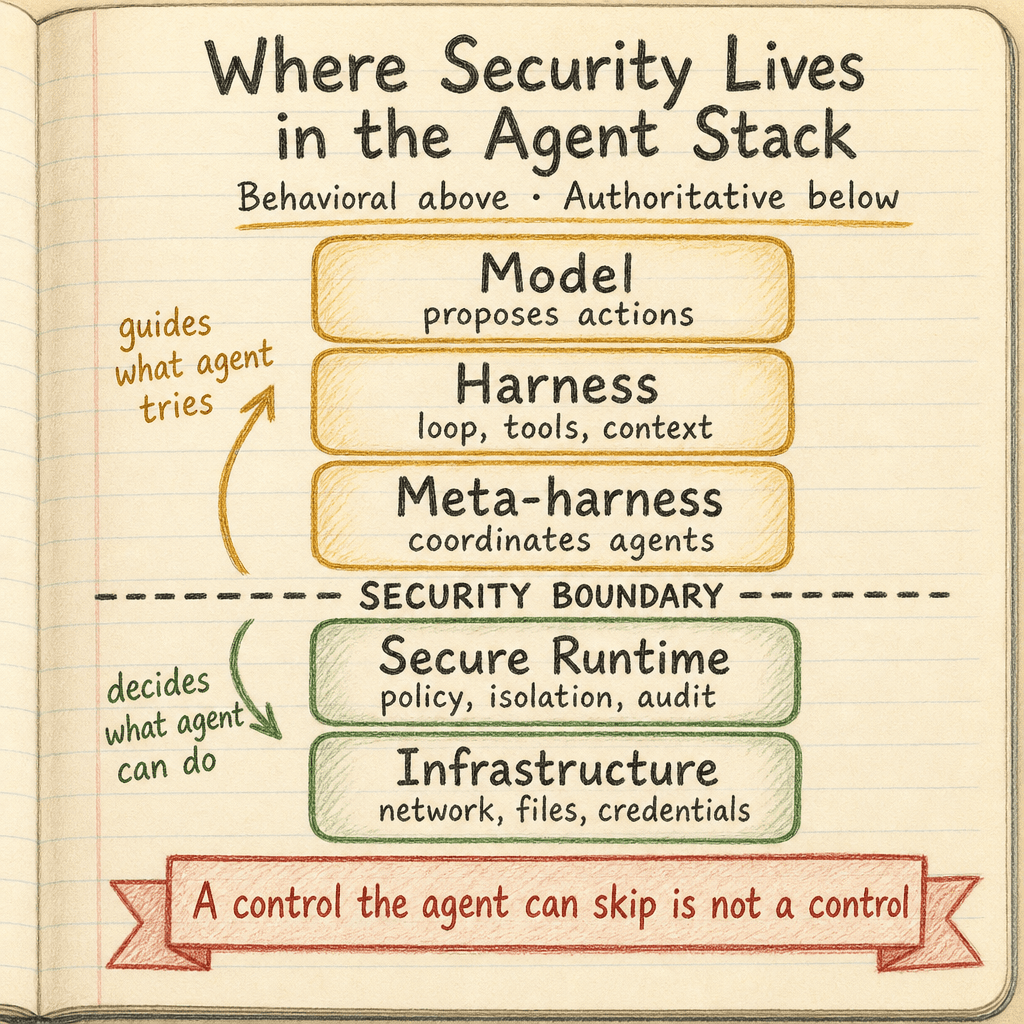
The harness guides what an agent tries. The infrastructure controls what an agent can do.
Both matter. Only one is authoritative.
The stack people actually ship
The emerging agent stack converges into roughly five layers:
| Layer | Role |
|---|---|
| Distribution / product | How users start and supervise agents |
| Meta-harness | Multi-agent coordination |
| Harness | Loop, tools, sessions, context |
| Secure runtime | Policy on effect paths |
| Inference / data plane | Model calls and data movement |
Capability research keeps pushing the harness upward. NVIDIA's AVO work hitting 100% on ARC-AGI-3 is a reminder: long-horizon agents get better at finding routes the original instructions never anticipated.
That is exactly why a programmable harness is a weak place to put security guarantees. A layer designed to be modified cannot reliably enforce against its own modification.
Behavioral vs infrastructure controls
Split the world into two buckets:
| Kind | Examples | Nature |
|---|---|---|
| Behavioral | prompts, model safeguards, harness steering, LLM-as-judge | Probabilistic guidance |
| Infrastructure | runtime policy on files, processes, network, credentials | Deterministic authorization |
NVIDIA's AI Red Team is blunt about the first bucket: defenses in the same control plane as the LLM — especially prompt-based defenses — are routinely subverted.
So the rule becomes:
Above proposes. Below decides.
Models, agents, and harnesses propose actions. Runtime and infrastructure authorize them. No layer grants itself authority.
Six gaps that keep showing up
When authorization can be influenced by the agent or by untrusted data, the same holes recur:
- Rules split across prompts, models, harnesses, and infra — nobody owns the boundary
- Standing credentials wider than the current task needs
- Untrusted tool output treated as instructions
- Uncontrolled external effects (egress, file writes, process spawn)
- Compounding delegation failures when agents share memory and call peers
- Incomplete audit evidence when something goes wrong
And the antipattern that quietly undoes the rest: treating the secure runtime as “just another tool” the harness can invoke after launch.
"A control the agent can decline to invoke is not a control."
What this looks like in code
The orchestrator plans. The runtime gates effects. Policy is fixed at launch — not rewritten mid-run by a clever tool call.
// Purpose: harness proposes; runtime authorizes before any side effect
type ProposedAction =
  | { type: "writeFile"; path: string; content: string }
  | { type: "http"; method: string; url: string }
  | { type: "spawn"; cmd: string; args: string[] };

interface RuntimePolicy {
  // Established at launch — not modifiable by the agent mid-run
  allowWrite(path: string): boolean;
  allowEgress(url: string): boolean;
  allowSpawn(cmd: string): boolean;
}

async function execute(
  action: ProposedAction,
  policy: RuntimePolicy,
  audit: (event: object) => void
) {
  switch (action.type) {
    case "writeFile":
      if (!policy.allowWrite(action.path)) {
        audit({ denied: action });
        throw new Error("write denied by runtime policy");
      }
      break;
    case "http":
      if (!policy.allowEgress(action.url)) {
        audit({ denied: action });
        throw new Error("egress denied by runtime policy");
      }
      break;
    case "spawn":
      if (!policy.allowSpawn(action.cmd)) {
        audit({ denied: action });
        throw new Error("spawn denied by runtime policy");
      }
      break;
  }
  audit({ allowed: action });
  return perform(action);
}
The important part is not the switch. It is that policy lives below the agent boundary and cannot be opted out of.
NVIDIA's OpenShell framing is similar: out-of-process policy across network, filesystem, process, and inference — closer to a browser-tab model for agents than another prompt instruction.
Orchestration graphs are not security policy
I've been building orchestration graphs for years. The DAG plans the work. It sequences tools. It retries failed nodes. It does not decide what files get written or what network calls go out.
That is a runtime job. Established at launch. Below the agent boundary.
If you hand a subagent a child scope, give it a child runtime ceiling it cannot exceed — not a longer system prompt that says “please stay in the sandbox.” Graphs coordinate. Runtimes decide.
Design rules that hold
- Nothing above the line grants itself authority
- Policy lives below the agent boundary
- Check every effect path
- Prefer just-in-time access over standing credentials
- Isolate sessions and preserve audit records
What to stop doing
| Stop | Why |
|---|---|
| Securing only the prompt | Same plane as the model — routinely subverted |
| Allowlists only in harness config | Agent-modifiable layers are not authoritative |
| Standing API keys in the agent env | Broader than the current task |
| LLM-as-judge as egress policy | Guidance ≠ authorization |
| Subagents inheriting parent credentials | Delegation without a ceiling |
Takeaway
The future is not “secure the prompt.”
It is above proposes; below decides.
Harnesses and graphs steer what an agent tries. Runtime and infrastructure decide what it can do. If your stack lets the loop skip, rewrite, or politely ignore the security layer, you do not have a security layer — you have a suggestion. Put authorization below the agent boundary, check every effect path, and keep that policy out of the agent's reach.